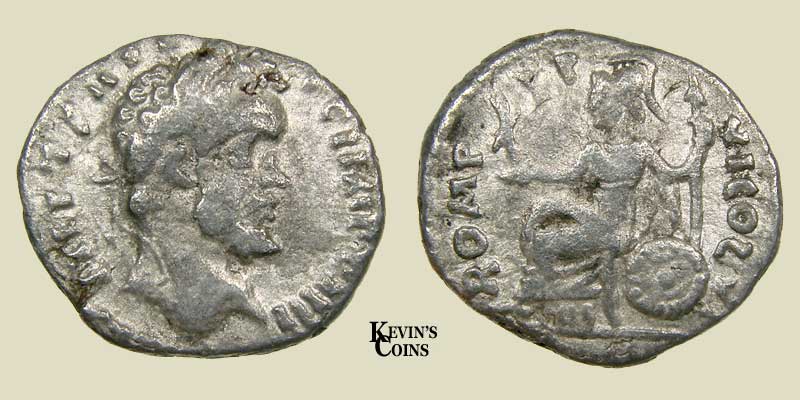
Silver Ancient Imitative Denarius


Silver Ancient Imitative Denarius (17.3mm 2.48g)

Obv:Meaningless legend Laureate bust right

Rev: ROMP PP VI COS VI "S" on COS in retrograde Roma seated left holding palladium and scepter sheild on ground at right.

ex. Ancient Imports

This coin is interesting because it’s basically an ancient counterfeit.

It's a silver imitative denarius styled after the Roman Emperor Septimius Severus (who ruled from 193 to 211 AD). "Imitative" means it wasn't made by the official Roman mint. Instead, someone outside the empire's borders—often referred to by historians as a "barbarous" or Germanic tribe—or a local underground counterfeiter struck this coin to mimic official Roman money.

Here is a breakdown of what is happening on this specific coin:

1. The Front (Obverse)

  • What you see: A portrait of a guy looking right, wearing a laurel wreath (the leafy crown of an emperor).
  • The "Giveaway": The website notes it has a "meaningless legend." The official mint workers in Rome knew exactly how to spell the Emperor's name. But the person who carved this coin's stamp likely didn't read or write Latin! They just copied what the letters looked like, turning them into random shapes that don't spell anything.

2. The Back (Reverse)

  • What you see: The goddess Roma sitting on a throne, holding a tiny statue (a palladium) and a spear, with a shield resting on the ground next to her.
  • The Letters: It says . The maker tried to copy official Roman titles, but mashed them together weirdly.
  • The "Oops" Moment: The letters are "retrograde" (backwards), and the letter "S" is stamped right on top of the word "COS". When making a coin die, you have to carve everything backwards so it prints correctly on the metal. The maker forgot to flip the letters when carving them, so they came out mirrored!

Why did people make these?

Roman silver denarii were the "US dollars" of the ancient world. Everyone trusted them, and tribes far beyond Rome's borders used them for trade. Because official Roman coins were in high demand, local metalworkers started making their own knock-offs to buy goods.

While an official coin has great historical value, an imitative coin like this is arguably even more fascinating—it shows a real snapshot of an ancient person trying their best to copy Roman technology and money!

Site hosted free courtesy of VCoins.com
Ancient Coins on Vcoins

Untitled 1

In an effort to spare you my horrible grammar and spelling, I use artificial intelligence to assist in content creation.

Visit My Blog

logo

Email Kevin

*